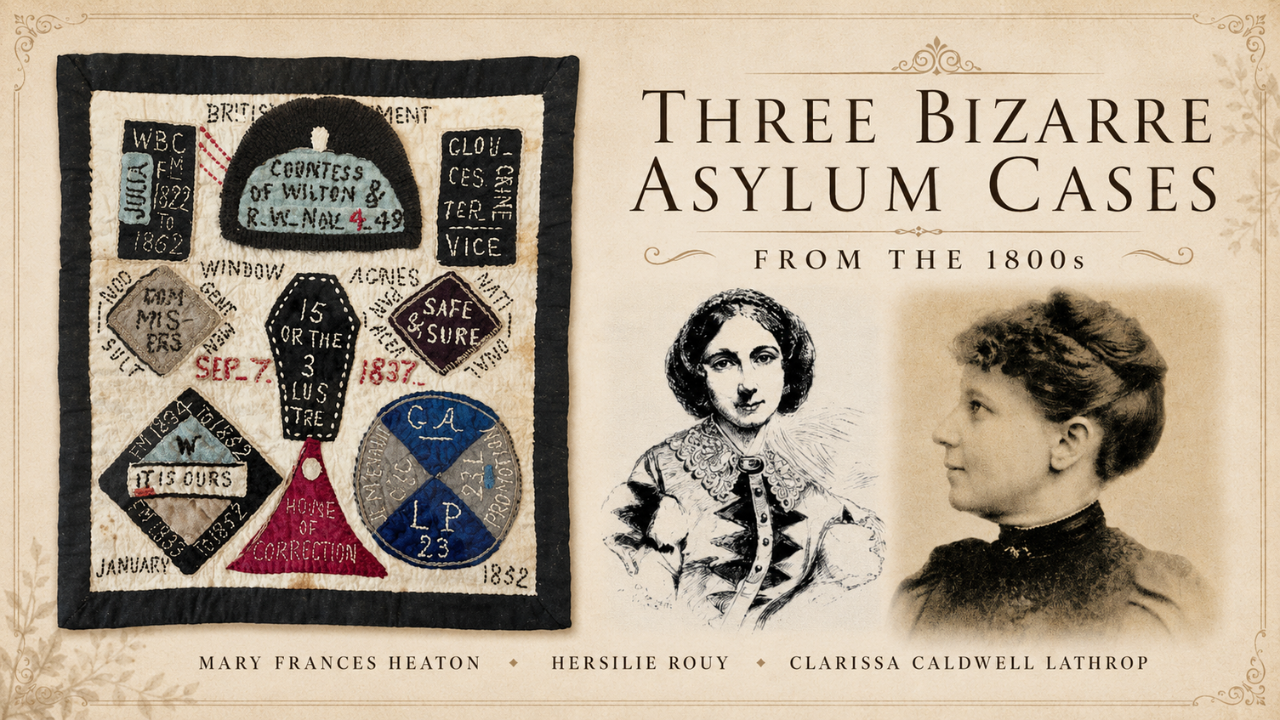
One woman was sent to an asylum after publicly confronting a clergyman she said had refused to pay her. Another spent years insisting that officials had confined her under the wrong identity. A third secretly wrote appeals for her freedom with a pencil barely an inch long.
In this podcast episode of Her Strange Hour, we look at the strange and unsettling cases of Mary Frances Heaton, Hersilie Rouy, and Clarissa Caldwell Lathrop.
Their stories took place in three different countries, but each woman faced the same frightening problem: once she had been declared insane, nearly everything she said could be dismissed as part of her illness.
Listen to the episode
Spotify episode:
https://open.spotify.com/episode/4h9UszzgIIuca3Nj1sQDhc?si=YV6QtOkoSpWKyP3BQKAwWw
Watch on YouTube:
https://youtu.be/1ZBUYA9xPzU?si=w1_bxKnvOSuasgV_.
Mary Frances Heaton and the stories she stitched
Mary Frances Heaton was a music teacher living in Doncaster, England. She claimed that Reverend John Sharpe had failed to pay her for lessons she provided to his daughter.
After Mary publicly confronted him and called him a liar, thief, villain, and hypocrite, she was arrested and taken to Doncaster Gaol. She was then declared a dangerous lunatic and admitted to the West Riding Pauper Lunatic Asylum without a trial or criminal conviction. She remained institutionalized for approximately 41 years.
While confined, Mary created unusual stitched samplers filled with names, dates, financial amounts, symbols, accusations, and fragments of her personal history. Some were directed toward powerful people, including one presented as a petition to Queen Victoria. Several of Mary’s surviving works are held by the Mental Health Museum in Wakefield.
Her samplers are especially important because they allow us to encounter Mary through something she created herself—not only through the medical records written about her.
Hersilie Rouy and the identity no one believed
Hersilie Rouy was a French pianist, composer, and music teacher. In 1854, she was placed in an asylum and registered under a version of the name Joséphine Chevalier rather than the public identity she repeatedly claimed as Hersilie Rouy.
For approximately fourteen years, Hersilie moved through French institutions while insisting that documents existed proving her name, family connections, and background. Her case was complicated because she also expressed beliefs that doctors regarded as delusional. But the existence of unusual beliefs did not mean that every statement she made was false—especially her statements about her own identity.
Hersilie was permanently released in 1868. Her writings were later compiled and published posthumously in 1883 as Mémoires d’une aliénée, or Memoirs of a Madwoman. The surviving memoir provides her version of her confinement alongside the institutional and administrative records that shaped her case
Clarissa Caldwell Lathrop and her secret notes
Clarissa Caldwell Lathrop entered the Utica asylum in New York in October 1880 after becoming convinced that someone was attempting to poison or drug her.
Clarissa’s poisoning suspicions were never independently proven. However, the question of whether every suspicion was accurate was separate from the question of whether she should remain confined without meaningful outside review.
According to Clarissa’s account, another patient gave her a pencil only about an inch long. She began recording her experiences on scraps of wrapping paper and along the margins of old newspapers. She concealed her writing in a hidden pocket sewn into her clothing.
Clarissa eventually contacted James Bailey Silkman, who helped obtain a writ of habeas corpus. After approximately 26 months of confinement, she was brought before a judge and discharged. She later published her story in the 1890 book A Secret Institution.
Clarissa Caldwell Lathrop and her secret notes
Clarissa Caldwell Lathrop entered the Utica asylum in New York in October 1880 after becoming convinced that someone was attempting to poison or drug her.
Clarissa’s poisoning suspicions were never independently proven. However, the question of whether every suspicion was accurate was separate from the question of whether she should remain confined without meaningful outside review.
According to Clarissa’s account, another patient gave her a pencil only about an inch long. She began recording her experiences on scraps of wrapping paper and along the margins of old newspapers. She concealed her writing in a hidden pocket sewn into her clothing.
Clarissa eventually contacted James Bailey Silkman, who helped obtain a writ of habeas corpus. After approximately 26 months of confinement, she was brought before a judge and discharged. She later published her story in the 1890 book A Secret Institution.
Her private scraps of writing became a published record the asylum could no longer intercept.
In this episode
You will hear about:
- The unpaid music lessons that preceded Mary Frances Heaton’s confinement
- The stitched samplers Mary used to record her story
- Hersilie Rouy’s fourteen-year struggle to reclaim her identity
- Why Hersilie’s case was more complicated than a simple question of sanity
- Clarissa Lathrop’s alleged poisoning fears
- The one-inch pencil and hidden pocket she used to document her confinement
- The legal effort that finally brought Clarissa before a judge
A note about these cases
These stories do not require us to claim that all three women were completely free from mental illness or that every allegation they made was factual.
The disturbing issue is what happened after each woman received the label of insanity. Once that label existed, even statements that could be supported by evidence became easier to disregard.
Mary, Hersilie, and Clarissa each created her own record—through thread, documents, or secretly written notes—so that the institution’s version would not be the only one left behind.
This article contains affiliate links. If you choose to purchase anything through these links, I earn a small commission at no additional cost to you. For the full disclosure, click here
Sources and further reading
- Mary Frances Heaton — Arts Café and the Mental Health Museum: An overview of Mary’s confinement and surviving stitched works.
- The Unravelling Fantasia of Miss H.: Background on Mary’s work as a music teacher, her commitment, and the samplers she created while confined.
- Mental Health Museum: Discovering Mary Frances Heaton: Discussion of the information packed into Mary’s surviving samplers.
- Hersilie Rouy, Mémoires d’une aliénée: Digitized edition of Hersilie’s memoir, originally published in 1883.
- Oxford Academic, “Mémoires d’une aliénée by Hersilie Rouy”: Scholarly examination of Hersilie’s confinement and autobiographical account.
- Clarissa Caldwell Lathrop, A Secret Institution: Digitized copy of Clarissa’s 1890 account of her confinement.
- Wellcome Collection, A Secret Institution: Archival catalog entry describing the book as Clarissa’s autobiographical account of her asylum experience


No Comments